Make Anything: A Handwritten Font That Elevates Your Brand
It was a rainy Tuesday morning when I sat down with three versions of my candle label—each one trying (and failing) to feel “me.” My small-batch soy candles sell at local markets and through my Etsy shop, and while customers love the scents and clean burn, something about the visuals felt… off. The font on my jar labels looked generic. The thank-you cards I hand-stamped felt disconnected from the rest of my brand. Even my Instagram story templates lacked that quiet confidence I wanted people to feel when they saw my name.
That’s when I discovered Make Anything.
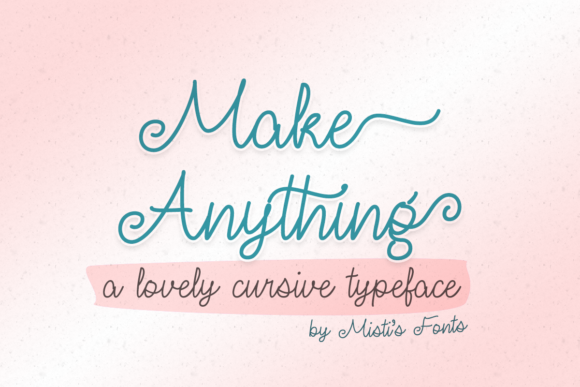
At first glance, it’s a handwritten font—but not the kind that tries too hard or feels like a child’s homework. Make Anything is a magical handwritten font carefully created with a touch of elegance. It balances timeless elegance and authentic calligraphy in a way that feels both personal and polished. There’s warmth in its curves, intention in its strokes, and just enough variation to keep it feeling human—not robotic or over-processed. It’s the kind of script font you’d imagine a skilled calligrapher writing slowly, deliberately, with ink that catches the light just right.
I started using Make Anything across everything: the bold title on my candle jars (“Lavender & Rain”), the delicate subheading on my packaging tape (“Hand-poured • Small Batch • Made with Care”), even the short line on my business cards (“Light your space, gently”). Suddenly, my brand didn’t just *say* something—it *felt* something. Consistent. Thoughtful. Trustworthy.
This isn’t just about prettier letters. Typography shapes first impressions faster than you think. When someone picks up your product, scrolls past your Instagram post, or opens your email newsletter, they’re not reading words—they’re absorbing mood, quality, and care. A rushed, mismatched font whispers “I threw this together.” But Make Anything says, “I paid attention—to every detail, including how my name looks on your shelf.”
Here’s where it shines most:
- Product labels & packaging: Perfect for candle jars, skincare bottles, tea tins, or bakery boxes—especially where short, evocative names or taglines live.
- Menus & café signage: Use it for dish names or seasonal specials—pair it with a clean sans serif for descriptions and prices.
- Social media graphics: Ideal for quote cards, launch announcements, or Instagram highlights—its elegance reads clearly even in small thumbnails.
- Thank-you cards & stickers: Adds sincerity without looking overly formal—great for handmade sellers who want warmth to come through in print.
- Website banners & digital ads: Works beautifully as display text—just avoid long paragraphs or tiny mobile body copy.
Because here’s the thing: Make Anything is a display font. It’s meant for headlines, logos, packaging titles, and decorative accents—not for paragraphs or fine print. On a candle jar lid? Gorgeous. In 8pt on a nutrition facts panel? Not ideal. For printed packaging, test it at actual size—some scripts lose legibility when scaled down, but Make Anything holds up well thanks to its open letterforms and balanced spacing.
Pairing it is simple and satisfying. I almost always go with a friendly, neutral sans serif—think Montserrat, Poppins, or Inter—for contrast and clarity. That combo gives me elegance *and* readability. If you're going for extra refinement, try a soft serif like Playfair Display or Lora. Just avoid stacking it with another heavy script—it can feel busy or indecisive. And if you’re designing for digital use, remember: Make Anything is part of the Script Amp collection, so it’s built with modern design workflows in mind—including OTF and TTF files, standard and extended Latin character sets, and common ligatures for smoother flow.
Before you drop it into your next project, double-check what’s included. Most versions of Make Anything offer stylistic alternates (like swash capitals or flourished endings), multilingual support for basic European languages, and full commercial licensing—so yes, you can use it on physical products, client work, digital templates, and even merch you sell. Just make sure your license covers your use case—especially if you’re bundling fonts into editable Canva templates or selling branded design assets.
What surprised me most wasn’t how beautiful Make Anything looked—it was how much *easier* branding became. Instead of agonizing over which font “feels right,” I now have one trusted go-to for moments that need heart and distinction. My holiday candle series launched last month with new labels using Make Anything for the scent names and a crisp sans serif for ingredients—and multiple customers mentioned how “cohesive” and “calm” the whole package felt. No one said “I love your font.” But they *did* say, “This feels like a brand I can trust.”
That’s the quiet power of good typography. It doesn’t shout. It settles in. It makes your customer pause—even for half a second—because something about it feels intentional, human, and true.
If you’ve ever stared at your logo mockup and thought, “It’s close… but not quite,” or spent hours tweaking label layouts only to feel like nothing ties together—that might not be a design problem. It might be a typeface problem. And sometimes, the fix is as simple as choosing a font that doesn’t just look good, but helps your business make anything—with clarity, charm, and quiet confidence.